
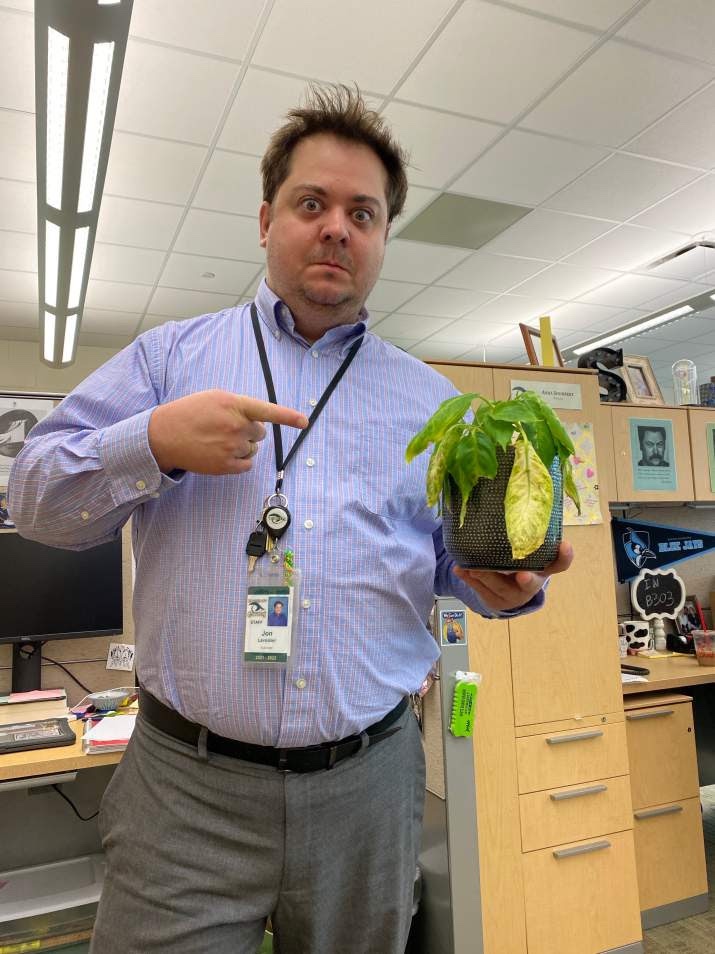
Sometimes we just need a little office humor to brighten our day. It’s Monday morning, and over 2000 young faces are entering the halls of education. They are lively, energetic, and very loquacious. And then there are those of us over the age of twenty who are struggling with the earliness of a Monday morning. My colleague is our residential horticulturist. He makes sure that those of us with plants are feeding and nurturing them as though they were family members. Shame on anyone who does not! One of my colleagues had a drooping plant, and our horticulturist exclaimed, “Lawd when she gets to the pearly gate, she won’t get in because the Lord is going to hold out this plant and say, ‘How do you think you’re going to get in here and this plant looks like this?’” The department erupted with laughter because it was just the humor needed to jumpstart the day! Another colleague said, “Yes, we are saving souls, one plant at a time!
”Isn’t that the truth?
We are in a position to have a great impact on young lives every day and be an influence on each other. While we may not impact the masses, we can try to influence one child along the way. I started thinking about what our department horticulturist said. What would you say if God looked at you and denied you entrance based on the condition of the plant? Let’s substitute the plant with your heart. Hmmm. Doesn’t the question have a different tone if the Lord asked you, “How do you think you’re going to get in here and your heart looks like this?” Whew! I don’t know about you, but I certainly did a quick inventory of my heart. If our purpose is to win souls, how can we have a drooping heart? At this moment what thoughts, criticisms are you carrying in your heart? One of the most memorable situations about the heart’s condition is found in 1 Samuel 15. The Lord was in search of a new king for the Israelites. He said, “I regret that I have made Saul king because he has turned away from me and has not carried out my instructions.” While Samuel was lamenting the rejection of Saul, the Lord made a profound statement, “Do not consider his appearance or his height, for I have rejected him. The Lord does not look at the things people look at. People look at the outward appearance, but the Lord looks at the heart.”
How many times have you looked at a person or a situation and made poor or wrong decisions because you were examining the exterior instead of the interior?I think about the student who doesn’t have a pen or pencil. I think about the young person who sleeps every day in class. I think about the poorly dressed woman riding the elevator with me. I think about the eleventh-grade student reading on a third-grade level. I think about the older lady who is ornery and mean-spirited. I think about the group lunch group’s idle table chatter about other people. I think about the young mother with babies attached to her ranging in age from 1 to 4 years old. I think about the driver of the old model car that makes noise, smokes, and sputters. I look at the young teen using WIC to buy formula for her infant. I look at people. I stop!
Imagine in your flesh that you are looking at the exterior of these scenarios and formulating thoughts. This is what we see. We think that the student without a pen or pencil is lazy and doesn’t care about school. We think there is no success for a child who sleeps in a class all day. We shake our heads with sadness at the junior who can barely read. We think that the old woman is just nasty and bitter. We think that young people have no great intellect because this is what they do. We think that the young mother is wild and promiscuous and has a different dad for each child. We think that the old sputtering car belongs to a thug or a “wannabe” gang member. We think that the young teen is acting grown and participating in unprotected sex. We look at the exterior of people. Let’s stop!
How do we look at the young lives in our care?
If we look through the eyes of Jesus we would see all of these scenarios differently. From an interior perspective, we would see a disadvantaged family that can’t afford school supplies and a young man who babysits younger siblings so that his parent(s) can work. The junior that barely reads above a third-grade level has been diagnosed with a severe learning disability. It’s not that she doesn’t want to do better; she has limitations. The old lady is lonely and needs acts of kindness. Being ornery is an attention mechanism. The young mother has two children, but her sister recently passed. She and her husband are adopting their niece and nephew to keep them out of the foster system. The old, smelly car is all the family can afford. It affords them transportation to get to work, pick up children, and grocery shop. The young teenager got caught up with an older guy who declared his undying love for her and played on her vulnerability and innocence. She refused to let one mistake destroy a life. See, when we look at the interior there’s more depth and meaning to each scenario.
This is the message that our horticulturist was telling us this Monday morning. Looking at the exterior, we saw a plant with drooping, limp, yellow, downtrodden leaves. We all saw an ugly plant near the brink of death. What would you do with this plant? If you lack a green thumb, you would probably throw it away or push it toward the back of the shelf to finish withering. Our horticulturist looked through a different lens to see the interior of the plant, its potential, and what it could become: a vibrant, healthy, green beauty. Suppose we took the time to see past the exterior and looked into the heart of the students we encounter daily.
Think about getting to the pearly gates and having a healthy green plant in your hand. What does the plant say about the condition of your heart? Simple: We are saving souls, one plant at a time.
Copyright ©️ 2021 by CrayDawg, Inc.
 Coffee Reflections